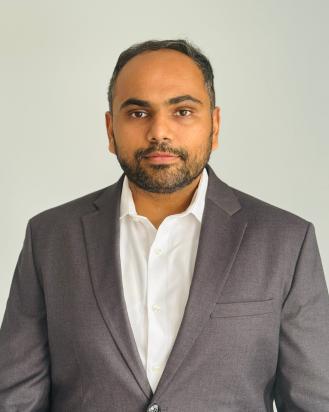
Darshil Patel
-
Assistant Professor, Criminal Justice
- Volatile Organic Compounds (VOCs), Human Decomposition Chemistry, Scent Detection Dogs, Gas Chromatography, Comprehensive Two Dimensional Gas Chromatography, Time of Flight Mass Spectrometry, Thermal Desorption, Solvent Free Sample Collection Techniques
Contact Info
- Email: darshil.patel@UND.edu
- Office: 701.777.4734
Office Address
O'Kelly Hall Room 239
221 Centennial Drive Stop 8050
Grand Forks, ND 58202-8050
Biography
Dr Patel's work centers on the chemistry of human decomposition, especially volatile organic compounds (VOCs), to improve detection, identification, and interpretation. He earned a Bachelor of Dental Surgery in India and a Master of Forensic Science at the University of Technology Sydney, completing an honours year. Immediately after his honours year, he worked as a Technical Officer and Research Assistant supporting research and operations at Australia’s first and only human taphonomic facility, the Australian Facility for Taphonomic Experimental Research (AFTER). He later completed his PhD while conducting research at the Research in Experimental and Social Thanatology (REST), Canada’s first taphonomic facility dedicated to research on human decomposition.
Dr. Patel’s research uses volatile organic compounds to profile the biochemical processes that drive human decomposition. He examines VOC signatures in cadavers, blood, bone, and remains recovered from submerged and buried contexts. Insights from this work support core forensic tasks such as detection and interpretation, and also translate to environmental monitoring and medical research. He has worked on multidisciplinary projects at AFTER and at the REST facility. Methodologically, he applies thermal desorption and single and multidimensional gas chromatography, including comprehensive two dimensional gas chromatography with time of flight mass spectrometry, to resolve complex chemical signatures. He received the University of Technology Sydney Dean’s Merit List for academic excellence in 2016.
At UND, Dr. Patel teaches and mentors students with an emphasis on application based learning, clear communication, and rigorous quality assurance and quality control. He guides students in experimental design, sample collection, GC and GC×GC method development, and transparent data analysis. He collaborates with forensic practitioners and technical experts and works with law enforcement partners in Australia and Canada to move methods from the lab to practice. He welcomes students interested in analytical chemistry approaches to real world forensic problems.
Research interests: Forensic Chemistry, Human Decomposition, Volatile Organic Compounds (VOCs), Gas Chromatography (GC, GC×GC TOFMS), Thermal Desorption, Solvent Free Sample Collection (SPME, TF SPME, HiSorb), Chemometrics, Method Development